

Travel Hacking for Families: A Complete Beginner’s Guide
Family travel is getting more expensive every year. Between four airplane seats, larger hotel rooms, and school-break surcharge pricing, taking a family vacation can easily feel financially out of reach.
Most people assume that "travel hacking"—using credit card points and airline miles to travel for nearly free—requires opening 50 different credit cards, managing complex spreadsheets, and spending hours gaming the system.
Here is the truth: You do not need dozens of credit cards to take your family on vacation with points.
By focusing on a handful of well-chosen cards, matching them to your regular household spending, and applying a simple, structured strategy, you can turn everyday expenses like groceries, gas, and utility bills into family vacations without taking on debt or hurting your credit score.
What Is Travel Hacking?
Stripped of its internet hype, travel hacking is simply the practice of leveraging credit card reward programs, airline miles, and hotel points to cover the cost of travel.
Why the Term Sounds Sketchier Than It Actually Is
The word "hacking" makes it sound like an underground loop-hole or a grey-area scam. In reality, points and miles are fully legal, officially sanctioned marketing programs created by banks, airlines, and hotels to build customer loyalty. "Hacking" just means using these programs intentionally rather than letting points sit idle.
Travel Hacking vs. Overspending for Rewards
True travel hacking is paying for purchases you were already going to make—like groceries, insurance, and daycare—using rewards credit cards, and then immediately paying off the balance. Overspending, buying things you don't need, or carrying a balance to earn miles is not travel hacking; it's just paying extra for a discount.
Why It’s So Useful for Families
For a single traveler, saving $300 on a flight is nice. For a family of five, saving $300 per flight means $1,500 saved on a single trip. Because family travel costs scale linearly with every added child, the savings compound massively when you use points.
Why Travel Hacking Is Different for Families
Most travel hacking guides on the internet are written by solo travelers or couples looking to fly first-class to Bali. Family travel operates under entirely different constraints:
1 Award Seat vs. 4, 5, or 6: Finding one open seat on points is relatively easy. Finding five adjacent seats on the same flight takes strategy and advance planning.
Fixed Travel Windows: Solo travelers can fly on a Tuesday in mid-November. Families are bound by school calendars, summer breaks, and holiday schedules when award space is most competitive.
Hotel Occupancy Limits: Standard hotel rooms in Europe and parts of Asia often max out at 2 or 3 guests. Families need suites, adjoining rooms, or vacation rentals, which changes how hotel points are redeemed.
Bigger Upfront Cash Costs: Paying cash for four or five long-haul tickets creates a major financial barrier. Reducing airfare to just the mandatory taxes and fees is often the only way a family trip becomes viable.
Why "Maximum Cents Per Point" Isn't Always the Goal: Point enthusiasts often obsess over getting 4 or 5 cents per point on international first-class seats. For a family, getting 1.5 to 2 cents per point to get all five of you to Disney World or Hawaii in economy class is a total victory. Utility beats perfection every time.
How Points and Miles Actually Work
Not all rewards are created equal. Understanding the four main types of rewards will keep you from collecting worthless points.
Bank Points (Transferable Points): Currency issued by banks (like Chase Ultimate Rewards, American Express Membership Rewards, Capital One Miles, and Citi ThankYou Points). These are the most valuable because you can transfer them to various airlines and hotels.
Airline Miles: Currency tied directly to a specific airline (like Delta SkyMiles or United MileagePlus). They are locked into that airline and its direct partners.
Hotel Points: Currency tied to hotel brands (like Hyatt, Marriott Bonvoy, or Hilton Honors). They are best used for free hotel nights.
Cash-Back Rewards: Simple fixed-value rewards (1 point = $0.01). Useful, but they lack the upside leverage that transferable bank points offer.
Why 100,000 Points Have Different Values Across Programs
100,000 points is not a universal measurement:
100,000 World of Hyatt points could easily cover 5–7 nights at a high-end family resort.
100,000 Hilton Honors points might only cover 1 or 2 nights at a similar property because Hilton’s award chart requires higher point counts.
The 3 Main Ways Families Earn Rewards
1. Welcome Bonuses
The single fastest way to earn points. When you open a new rewards card and hit a minimum spending threshold in the first 3–6 months, the bank awards a large block of bonus points (e.g., 60,000 to 100,000 points).
2. Everyday Category Spending
Credit cards offer bonus multipliers on everyday family expenses. Using a card that earns 3x on groceries, 3x on dining, or 2x on all purchases adds up steadily over a year.
3. Shopping Portals and Promotions
Before making online purchases (from retail to back-to-school shopping), clicking through an airline or bank shopping portal (like Chase ShopThrough or Rakuten) earns extra points per dollar spent on top of your credit card earnings.
Why Welcome Bonuses Matter So Much
Earning points solely through regular spending takes time. If you spend $1,000 a month on a card earning 1 point per dollar, it takes over four years to accumulate 50,000 points.
A single welcome bonus can grant 60,000 to 100,000+ points in 90 days for spending money you were already planning to spend.
How Spending Requirements Work (Hypothetical Family Budget)
Suppose a card offers a 75,000-point bonus after spending $4,000 in the first 3 months. For a typical household, that threshold is met easily by routing standard expenses through the card:
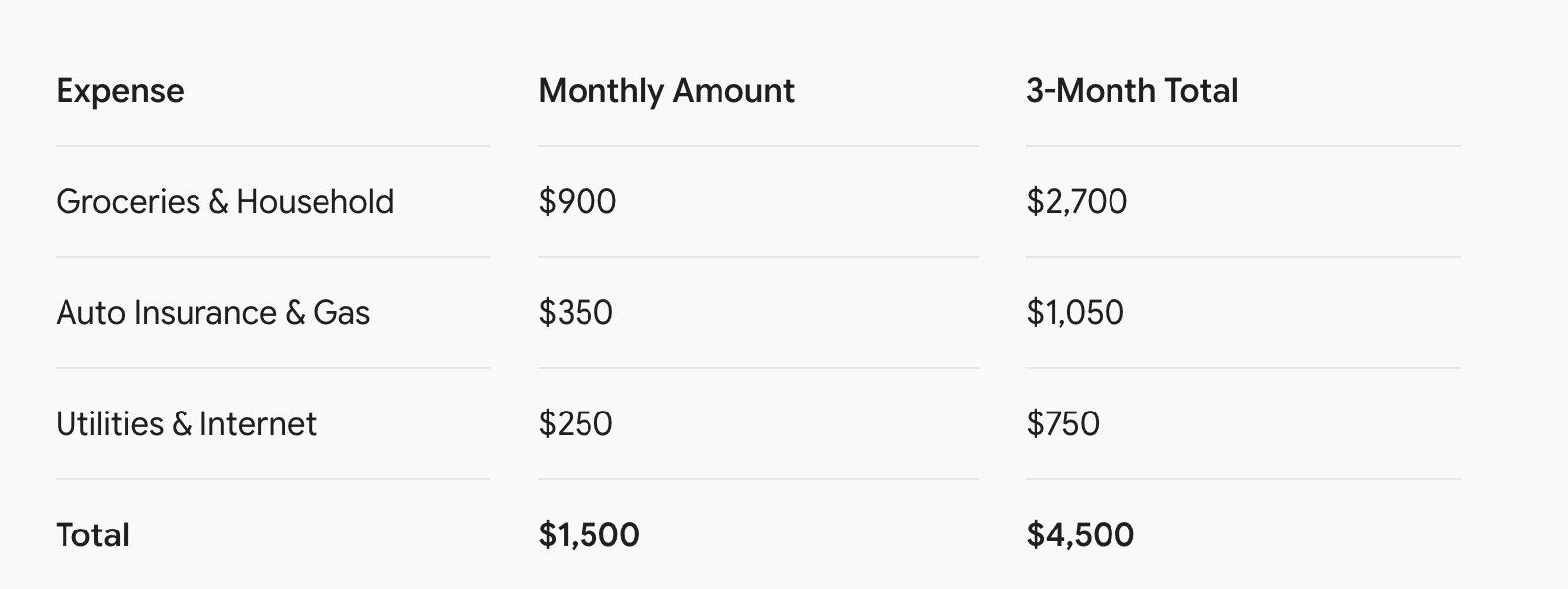
Without altering your lifestyle or spending an extra dollar, the requirement is met, and the bonus is secured.
Golden Rule: Never create artificial spending or buy items you don't need just to hit a credit card welcome bonus.
The Absolute Golden Rule: Never Pay Interest for Points
If you carry a credit card balance and pay interest, travel hacking fails instantly.
Credit card interest rates typically range from 20% to 30%. The maximum value you will extract from travel points usually ranges from 1.5% to 3%. If you pay even one month of credit card interest, the cost of that debt erases the financial value of the points you earned.
Who Should Wait Before Starting?
Anyone currently carrying high-interest credit card debt.
Anyone who struggles with impulse buying when using credit instead of debit/cash.
Anyone actively preparing to apply for a mortgage in the next 3 to 6 months.
Pay off existing balances first. Travel hacking is a financial optimization tool—it only works on a stable foundation.
What Are Transferable Points?
If you only remember one concept from this guide, make it this: Focus on transferable bank points.
Programs like Chase Ultimate Rewards, American Express Membership Rewards, Capital One, and Citi allow you to keep your points in a central bank account and transfer them 1:1 to dozens of different airline and hotel loyalty programs when you are ready to book.
Why Flexibility Is Critical for Families
If you earn 100,000 Delta Miles and Delta has no award seats available for your family’s spring break trip, those miles are stuck.
If you have 100,000 Chase or Capital One points, you can check United, Southwest, British Airways, or Air Canada, and move the points to whichever airline actually has 4 or 5 seats open.
Warning: Transfers are a one-way street. Once you move bank points into an airline or hotel program, you cannot transfer them back to the bank. Only transfer points when you have confirmed availability and are ready to book immediately.
What Is a Transfer Partner?
Think of a bank like a currency exchange booth at an international airport. Your bank points are your base currency, and the transfer partners are the specific foreign currencies you can trade them for.
Because airlines form global alliances (Star Alliance, SkyTeam, Oneworld), transferring points to one partner often unlocks flights on dozens of partner airlines worldwide.
For example:
You can transfer Chase points to British Airways.
You can then use British Airways Avios to book short-haul domestic flights on American Airlines or Alaska Airlines—often for fewer points than booking directly through American.
Cash Price vs. Points Price
A high cash price doesn't always mean a trip requires a huge number of points, and a cheap cash price doesn't mean points are a good deal. Always calculate the cents per point (CPP) before booking:

A simple equation to determine how many cents your point is costing you
Example Scenarios:
Scenario A (Great Points Redemption): Flights to Europe cost $1,200 cash per ticket, or 30,000 points + $50 in taxes.
$(\$1,200 - \$50) / 30,000 = \mathbf{3.8\text{ cents per point}}$ (Excellent value—use points).
Scenario B (Poor Points Redemption): A domestic ticket costs $110 cash, or 15,000 points + $5 in taxes.
$(\$110 - \$5) / 15,000 = \mathbf{0.7\text{ cents per point}}$ (Poor value—pay cash and save points for later).
How Award Flights Work for Families
Airlines do not make every seat available for points. They allocate a specific number of award seats per flight based on expected demand.
Award Availability: The inventory of seats an airline sets aside to be booked with miles.
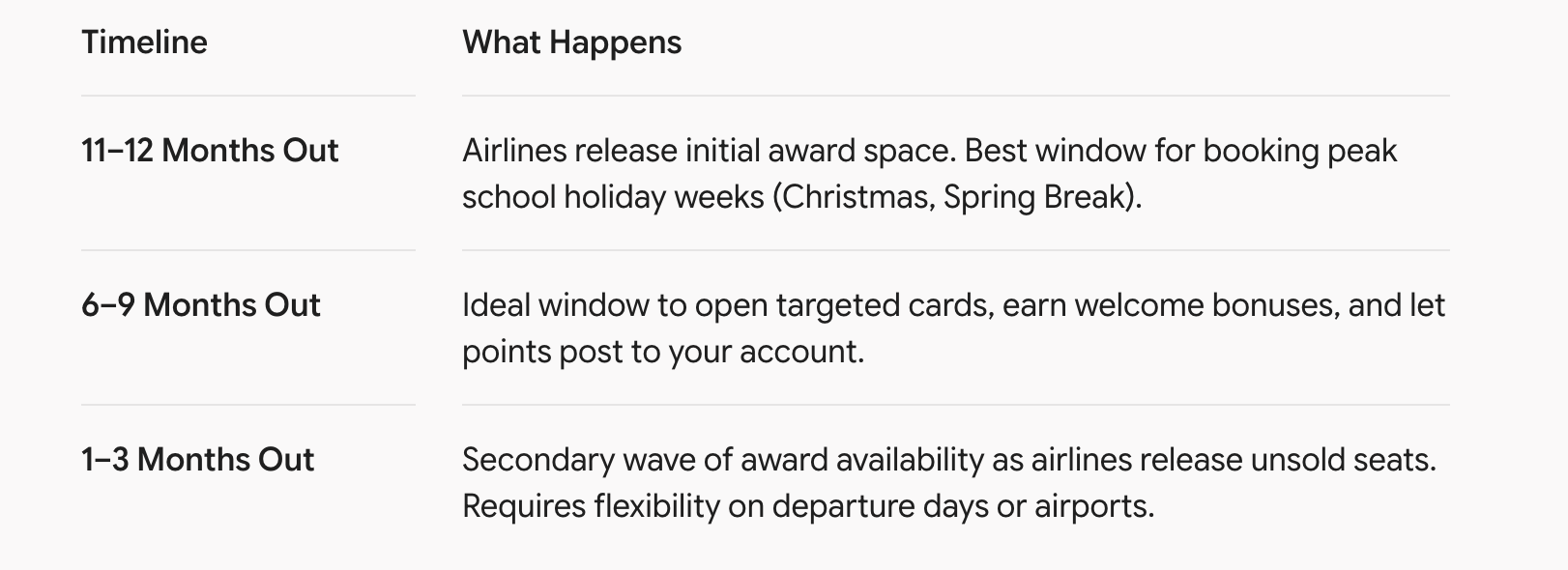
Finding 5 Seats: Airlines might only release 2 or 3 saver-level award seats on a popular route initially. To get 4 or 5 seats, families need to search early (11 months out when schedules open) or look at airlines like Southwest that allow any open seat to be booked with points.
Taxes & Fees: "Free" flights still require cash to cover government taxes and airport fees. For US domestic flights, this is typically $5.60 per segment. For international flights, taxes can range from $50 to several hundred dollars depending on the departure airport.
How Hotel Points Work for Families
Hotel points are often easier to use for families than airline miles because hotels don't restrict award space as tightly as airlines do.
Navigating Occupancy Rules
In the U.S., a standard double-queen room comfortably fits 4 people. In Europe and Asia, standard award rooms often max out at 2 adults or 2 adults + 1 small child.
Look for hotel chains (like Hyatt) that offer clear room occupancy details upfront or allow you to redeem slightly more points for entry-level family suites.
How Much Do Families Need to Spend to Make This Work?
You do not need a high-six-figure income to earn meaningful travel rewards. Normal household expenses—groceries, gas, insurance, cellular bills, utilities, sports fees—add up to thousands of dollars every quarter.
By systematically shifting existing household expenses onto one targeted rewards card at a time, a typical middle-class family can easily generate 100,000 to 200,000 points per year.
Can You Travel Hack Without Opening Tons of Cards?
Yes. You do not need 20 credit cards.
A simple, highly effective "Two-Four Card Strategy" is all most families ever need:
Card 1 (Core Ecosystem Card): Earns elevated bonus points on primary household categories (e.g., groceries, dining, streaming).
Card 2 (Flat-Rate Catch-All Card): Earns 2x points on everything else (utilities, medical bills, auto maintenance, kids' activities).
This keeps annual fee tracking simple, prevents account clutter, and consistently feeds points into a single transferable currency.
What About Your Credit Score?
A common fear is that opening cards will ruin your credit score. Understanding how credit scores are calculated helps demystify this:
Payment History (35%): Paying on time is the single largest factor. Never miss a payment.
Credit Utilization (30%): The percentage of available credit you use. Opening new cards increasesyour overall credit line, which can actually lower your utilization ratio and help your score.
Length of Credit History (15%): Keep your oldest no-annual-fee cards open long-term to anchor your average account age.
New Credit/Inquiries (10%): Opening a card triggers a hard inquiry, causing a temporary dip of 3 to 5 points. For a responsible credit user, this recovers quickly over a few billing cycles.
Credit Mix (10%): Having a healthy variety of credit accounts.
Responsible credit card use (paying balances in full every month) maintains strong credit over time.
8 Common Beginner Mistakes to Avoid
Redeeming Points for Merchandise or Gift Cards: Getting a $50 toaster for 10,000 points values your points at 0.5 cents each. Save them for travel where they are worth 2x to 4x more.
Collecting Random, Fragmented Currencies: Having 5,000 miles across six different airlines is useless. Focus on accumulating a solid balance in one flexible bank currency.
Ignoring Point Expiration Rules: Some airline miles expire after 12–24 months of account inactivity. Bank points do not expire as long as your card account remains open and in good standing.
Missing Minimum-Spend Deadlines: Set calendar alerts. Missing a welcome bonus by $50 because you miscalculated the 90-day window is a painful mistake.
Carrying a Balance: Paying interest voids all rewards value.
Booking Travel Before Checking Award Availability: Never transfer points assuming seats will be open. Confirm the seats are available first.
Speculative Transfers: Transferring points to an airline without an immediate booking plan traps your points in that single airline program.
Chasing Luxury Over Family Utility: Don't pass up 5 economy seats to Hawaii for your family because you're holding out for a single business-class seat for yourself.
A Simple 7-Step Beginner Strategy
Step 1: Pick one specific trip (Destination + Dates + Passengers).
Step 2: Inventory existing points across all family accounts.
Step 3: Search cash prices for flights and hotels to establish a benchmark.
Step 4: Identify which points currency transfers to the options you need.
Step 5: Apply for one card that earns that currency and meet the spending goal via normal bills.
Step 6: Search award inventory directly on airline/hotel partner sites.
Step 7: Transfer points and book immediately once space is confirmed.
Real-World Example: Family of 5 Heading to Europe
Goal: 5 economy seats from Chicago to London for summer break.
Cash Airfare Estimate: $1,100 per seat = $5,500 total.
Points Route: Virgin Atlantic or Flying Blue (Air France/KLM) often release 5+ economy award seats on transatlantic routes for ~15,000 to 20,000 points per person each way during promotional periods, plus taxes/fees.
Execution: A couple opening one high-bonus transferable point card each could earn 120,000–150,000 total points—enough to cover the bulk of the transatlantic flights for the whole family, cutting an intimidating $5,500 airfare bill down to standard airport taxes.
How Far in Advance Should Families Plan?
Helpful Tools to Bookmark
Google Flights: The best tool for setting cash price baselines and checking route schedules.
Point.me or Seats.aero: Award search engines that aggregate points availability across multiple airline loyalty programs.
AwardWallet: A tracking app that securely keeps all your family’s point balances, expiration dates, and account numbers in one place.
Our Family Travel-Hacking Rules
Never carry debt for rewards.
Never spend extra money just to earn points.
Always check the cash price before redeeming points.
Never transfer points without a live booking waiting.
Prioritize getting the whole family there over chasing perfect "luxury" valuations.
Keep your card portfolio simple and manageable.
Your First Travel-Hacking Homework
Welcome! Taking your family on vacation using points and miles doesn't require dozens of credit cards or complex spreadsheets. It starts with clarity.
Use this quick planning worksheet to inventory your starting point, define your travel goal, and map out your points strategy before you apply for a single card.
Not sure where to start? Download our free Family Travel Hacking Starter Guide to map out your answers and build your family's customized points plan step-by-step!